Anatomy Explorer Lab - Module 3 - Internal Brain: Gray Matter Page 3 of 3
Goals
Continue exploring the brain and remember to
click on the hyperlinks for bookmarked views, and follow the instructions in the VHD below.
Tap on image to enlarge
Hippocampus. The hippocampus is a major limbic system structure involved in learning and memory. It is especially important for consolidating declarative memories and for spatial memory. Although it is critical for memory formation, it is not the site of long-term memory storage. Damage to the hippocampus, such as in Alzheimer disease, hypoxic injury, or traumatic brain injury, can impair the formation of new memories and may cause anterograde amnesia.
Hippocampus. Identify and highlight the left and right hippocampus on the 3D model.
Rotate the model and describe the relationship of the hippocampus to the other structures, particularly the amygdala and the thalamus.
Orient yourself to ventral, dorsal, rostral, and caudal. [Feel free to remove structures as needed to better view the hippocampus.]
Coronal Cross-Section. Identify and highlight the left and right hippocampus on the cross-section image.
Use the 3D model to observe the hippocampus and its relationship to the MRI slices.
Observe the highlighted hippocampus in the cross-sections panel as you scroll through the MRI.
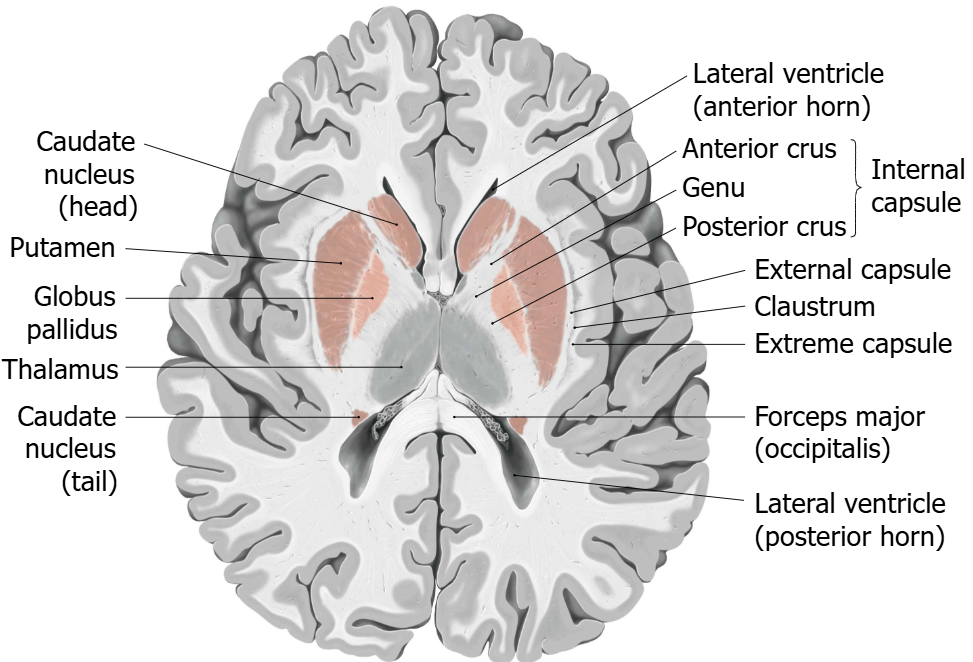
Axial Cross-Section. Identify and highlight the left and right hippocampus on the cross-section image.
Use the 3D model to observe the hippocampus and its relationship to the MRI slices.
Observe the highlighted hippocampus in the cross-sections panel as you scroll through the MRI.ding structures on the right side of the model.
Sagittal Cross-Section. Now, overlay the sagittal cross-section over the 3D model to explore the hippocampus.
Congratulations! You've explored the gray matter of the brain! Now, move on to examine the white matter.