
Neurology Lab 2 - Module 1 - Vertebral Column: Page 3 of 5
| View the vertebral column. |
| Using the Highlight tool, now highlight the lumbar vertebrae one by one and note their orientation and anatomical relationships on the transverse, sagittal and coronal cross-sections. |
At what vertebral level does the spinal cord end in an adult? |
|
|
Typically, the spinal cords ends around the L1-L2 vertebral level in an adult. At birth, the spinal cord typically ends around the L3 vertebral level. |
|
Why are the spaces between the posterior aspects of the L2, L3, L4, and L5 vertebrae clinically important? |
|
|
These spaces (especially L3/L4 and L4/L5) provide safe access to the subarachnoid space for procedures like lumbar puncture and spinal anesthesia. |
|
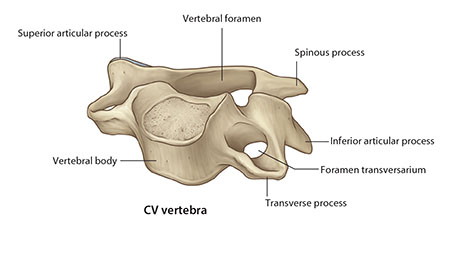
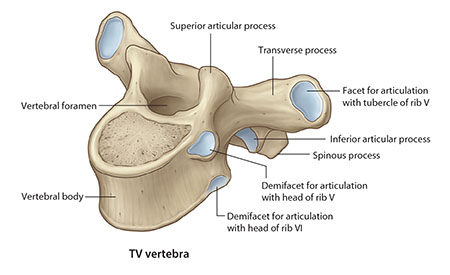
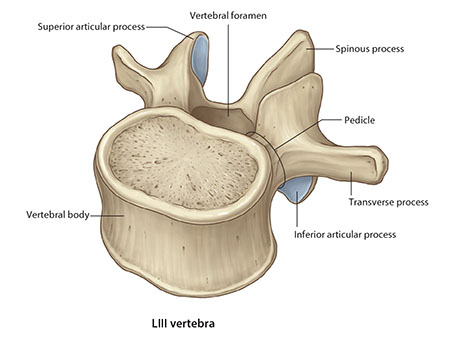
| Compare the lumbar vertebrae to the thoracic and cervical vertebrae. |
 |
 |
 |
Sports involving repeated lumbar extension combined with rotation, such as gymnastics or diving, increase the risk of fracture to what anatomic structure? |
|
|
The pars interarticularis. The pars (part) interarticularis (between the articular processes) is a small segment of vertebral bone connecting the superior articular process to the ipsilateral (on the same side) inferior articular process. On an oblique lumbar X-ray, this is the "neck" of the Scottie dog. |
|