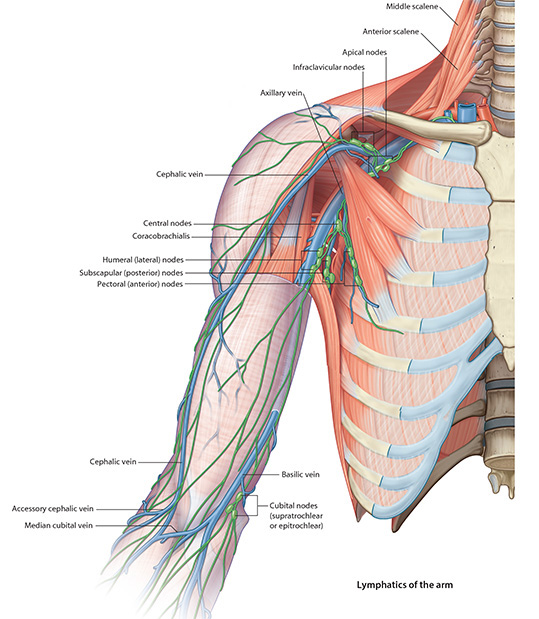
The Axillary Vein lies anteromedial side to the axillary artery. The axillary vein begins at the inferior border of the teres major muscle, as a continuation of the brachialand basilic veins. It ends at the lateral border of the first rib where it becomes the subclavian vein. This relationship make the axillary vein vulnerable during axillary surgery or central access.
The axillary vein is formed where the Basilic Vein joins with the venae comitantes (paired deep brachial veins).
The Axillary Vein receives tributaries roughly corresponding to the axillary artery branches. It ends at the lateral border of the first rib, where it becomes the Subclavian Vein. Deep arteries in the limbs commonly have paired venae comitantes (two veins per artery).
Superior to the pectoralis minor, the Cephalic Vein drains into the axillary vein, typically in the deltopectoral region.
The Axillary Sheath is a lateral extension of the prevertebral (pretracheal) deep cervical fascia that follows the cervicoaxillary canal and encloses the axillary artery and cords of the brachial plexus. The axillary vein lies anteromedial and usually outside the sheath. The axillary sheath is a landmark for interscalene and axillary nerve blocks and it helps predict the local spread of infection or blood from a hematoma.
Explore the sectional anatomy of this region, making certain to see the axillary artery and vein on the transverse section.