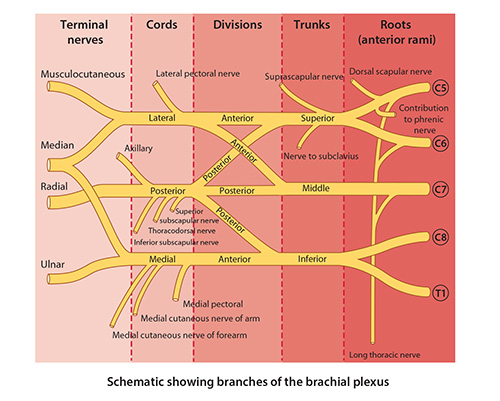
The branches of the brachial plexus may be divided into supraclavicular branches and infraclavicular branches. Only the infraclavicular branches are approachable through the axilla.
While the entire brachial plexus is reviewed here, pay special attention to the segments emphasized in the HSF course. For HSF 1A, that includes the relevant axillary and pectoral branches covered during the limbs session. For HSF 2B, you are responsible for all of the branches.
Lateral Cord Branches
Tap on image to enlarge
The Lateral Pectoral Nerve – from C5 – C7 and supplies the pectoralis major muscle.
Clinical pearl: implicated in post-op chest wall weakness and pain.
The Musculocutaneous Nerve – one of the two terminal branches of the lateral cord. Supplies the muscles of the anterior arm (coracobrachialis, biceps brachii, and brachialis). It, typically, pierces the coracobrachialis muscle and travels distal deep to the biceps brachii muscle. Just proximal to the elbow it emerges superficial, lateral to the distal biceps tendon and is now called the lateral antebrachial cutaneous nerve (or lateral cutaneous nerve of the forearm).
Clinical pearl: injury results in weakened elbow flexion and loss of lateral forearm sensation.
The Lateral Root of the Median Nerve – the other terminal branch of the lateral cord; joined by the medial root of the median nerve to form the median nerve. (This nerve is not visualized on the 3D cadaver)
Medial Cord Branches
The Medial Pectoral Nerve – (C8-T1) enters the deep surface of the pectoralis minor to supply it and the sternocostal head of the pectoralis major. (This nerve is only visualized on the left side of the 3D cadaver)
The Medial Brachial Cutaneous Nerve(medial cutaneous nerve of the arm) – supplies the skin over the medial surface of the arm – purely sensory. It unites with the intercostal brachial nerve (2nd intercostal nerve) to supply this area.
The Medial Antebrachial Cutaneous Nerve(medial cutaneous nerve of the forearm) – supplies skin over the medial surface of the forearm – purely sensory.
The Ulnar Nerve - (C8-T1, occasionally includes some C7 fibers) A terminal branch of the medial cord of the brachial plexus; supplies one and one-half muscles in the forearm, most of the intrinsic muscles of the hand, and some sensory territory.
Clinical pearl: injury results in loss of finger abduction and adduction and grip weakness. The site of injury has a large impact on symptoms.
The Medial Root of the Median Nerve – other terminal branch of the medial cord; joins the lateral root to form the median nerve which supplies most of the flexor muscles of the forearm and some of the muscles of the hand. Innervates some of the skin of the hand..
Posterior Cord Branches
The Upper Subscapular Nerve – (C5-C6) supplies the supscapularis muscle.
The Thoracodorsal Nerve – (C6-C8) supplies the latissimus dorsi muscle; arises between the upper and lower subscapular nerves.
The Lower Subscapular Nerve – (C5-C6) supplies part of the subscapularis muscle and all of the teres major muscle.
The Axillary Nerve – (C5-C6) one of the terminal branches of the brachial plexus; passes to the posterior aspect of the arm through the quadrangular space along with the posterior circumflex humeral vessels; supplies articular branches to the glenohumeral joint; after emerging from the quadrangular space it winds around the surgical neck of the humerus to supply the deltoid and teres minor muscles; it terminates as the superior lateral brachial cutaneous nerve supplying sensory to the superior lateral aspect of the skin covering the deltoid muscle.
Clinical pearl: surgical neck humeral fractures often injury the axillary nerve, resulting in deltoid paralysis and loss of shouler abduction beyond 15° and lateral shoulder sensation.
The Radial Nerve – (C5-T1) The other terminal branch of the posterior cord; provides the major nerve supply to the extensor muscles of the arm and forearm; as it leaves the axilla the radial nerve runs between the long and lateral heads of the triceps brachii muscle to enter the radial (spiral) groove of the humerus; gives off the posterior brachial cutaneous and posterior antebrachial cutaneous nerves. As it enters the forearm it branches into a superficial and deep branch. The deep branch travels under the supinator muscle and emerges as the posterior interosseous nerve. The superficial radial nerve travels to the hand where it supplies sensory to part of the thumb and dorsum of the hand.