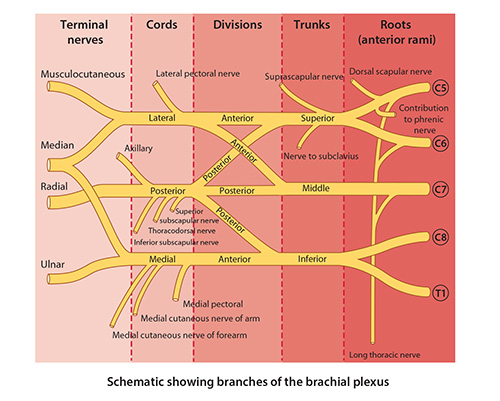
The Brachial Plexus is a network of nerves that extends from the neck into the axilla and supplies motor, sensory, and sympathetic fibers to the upper limb. The brachial plexus is formed by the ventral rami of C5–T1, which emerge between the anterior and middle scalene muscles in the cervical region (neck).
Tap on image to enlarge
Begin with the Pectoral girdle with the pectoral muscles removed.
Add the Ventral primary rami of C5 and C6. These roots lie between the anterior and middle scalene muscles.
C5 and C6 unite to form the superior (upper) trunk. Note: the suprascapular nerve and nerve to the subclavius branches arise here.
Add the Ventral primary rami of C7.
C7 continues as the middle trunk.
Add the Ventral primary rami of C8 and T1.
C8 and T1 unite (at the neck of the first rib) to form an inferior (lower) trunk. The inferior trunk lies posterior to the subclavian artery and superior to the first rib.
Each of the three trunks split into anterior and posterior divisions posterior to the clavicle. These divisions are important because they represent developmental features that translate into function: anterior divisions mainly supply the flexor (anterior) compartments and the posterior divisions mainly supply extensor (posterior) compartments of the upper limb.
Add the anterior division of the superior (upper) trunk.
Add the posterior division of the superior (upper) trunk.
Add the anterior division of the middle trunk.
Add the posterior division of the middle trunk.
Add the anterior division of the inferior (lower) trunk.
Add the posterior division of the inferior (lower) trunk.
Now, take a moment to add the cross-section panel and a transverse anatomic cross-section to the 3D model to examine the brachial plexus.